


Hong Kong AI Safety & Governance: Local Ecosystem & What’s Missing

A reference page for Hong Kong-based learners, practitioners, and advocates.
Last updated April 2026.
This is cross-posted from the AI Safety HK Substack Blog.
Summary:
Part 1 — Local resources page, organised as a navigable ecosystem map across the five main HK institutions (DPO, PCPD, Cyberport AISC, university centres, and AISA), with direct hyperlinks, a brief description of each resource, and what it actually covers so readers know where to start.
The substantive AI safety conversation in Hong Kong (covering catastrophic risk, value alignment, and the long-term trajectory of AI) lives almost entirely in philosophy departments, not in public institutions, which remain focused on data privacy and compliance.
Part 2 — Gap analysis, which makes an honest case for seven things Hong Kong is missing relative to the global conversation:
No dedicated AI Safety Institute — Unlike the UK, US, Singapore, Japan, and others, HK has no body doing technical red-teaming or model evaluations .
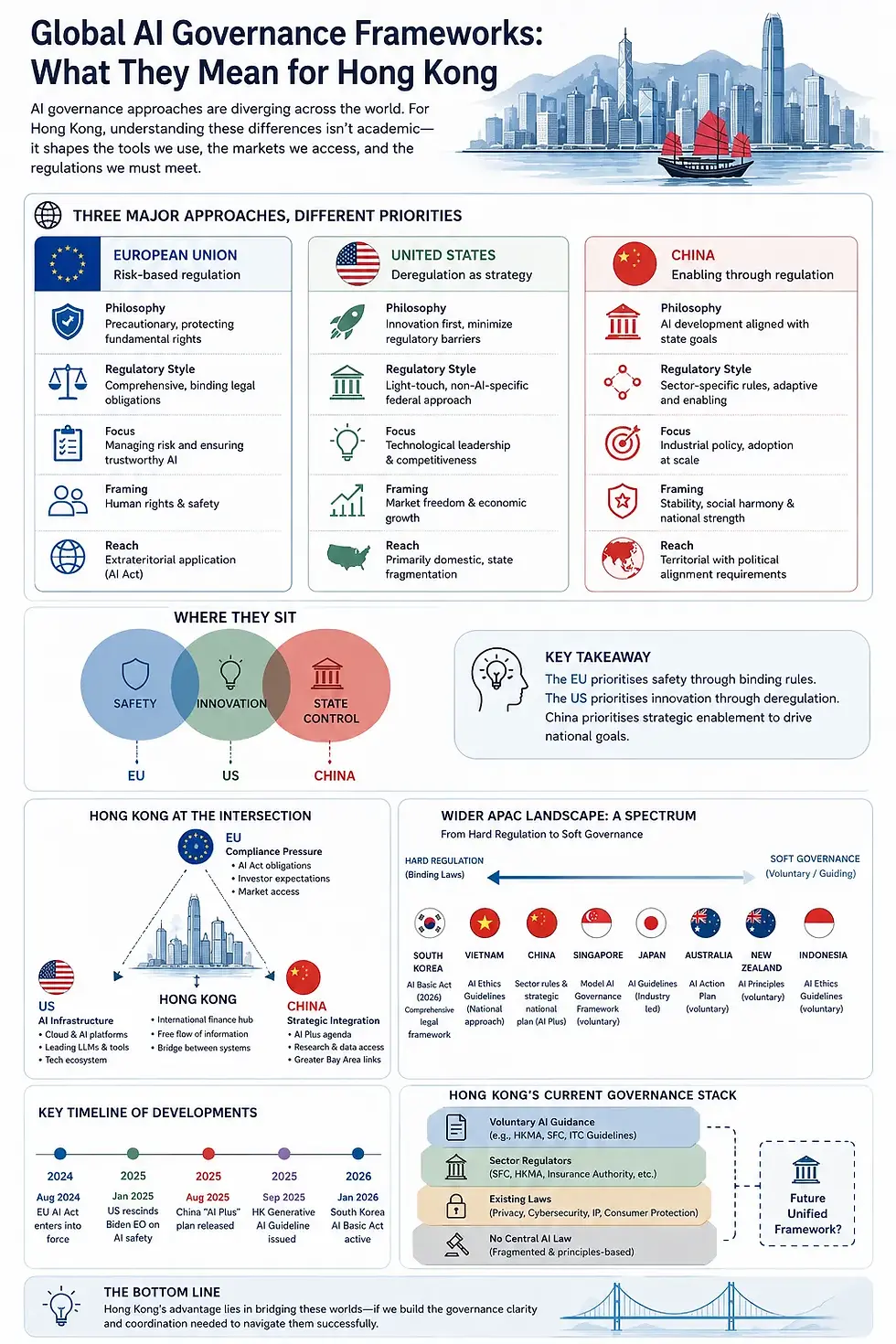
No binding AI law — Every framework remains voluntary while the EU AI Act is already in force and Mainland China has binding regulations covering recommendation systems (2022), deepfakes (2022), and generative AI services (2023).
No talent pipeline — Training pushes AI application skills; nothing like the ERA or IAPS fellowship model exists locally.
Civil society is thin — AISA is the only visible actor but focuses regionally; no HK-specific public interest watchdog exists.
No centralised technical AI safety hub— While local universities regularly publish on interpretability, robustness, and capability evaluation, this technical research is highly fragmented. Hong Kong has nothing like a Cambridge AI Safety Hub to unify empirical machine learning teams with the philosophical and governance work of groups like HKCRC or the HKU AI & Humanity Lab. Crucially, the absence of a dedicated centre means there is no structural anchor to incentivize systemic AI safety collaboration across academia, the private sector, and civil society.
Weak international connectivity — Singapore sits at the Hiroshima/Paris/Seoul tables; HK remains a “relative latecomer” to frontier safety diplomacy
No AI incident reporting mechanism — The PCPD hotline handles privacy queries but is not an accountability instrument for AI harms.
Part 1 — Hong Kong Institutional Ecosystem
🏛️ Digital Policy Office (DPO)
The DPO is the primary government body coordinating AI policy in Hong Kong. Its frameworks set the tone for public-sector and general organisational AI governance.[1]
Resource | Link | What it covers |
Ethical AI Framework (general orgs edition) | 12 guiding principles, leading practices, and AI assessment templates for any organisation[1] | |
Hong Kong Generative AI Technical & Application Guideline (2025) | Practical guidance on scope, risks (data leakage, model bias), and governance principles for GenAI. Drafted by HKGAI on DPO's commission[1][2] | |
AI Subsidy Scheme portal | HK$3 billion scheme to subsidise AISC compute for universities, enterprises, and government; includes cybersecurity and data-protection conditions[3] |
Note: Hong Kong has deliberately chosen a soft law approach; all DPO materials are voluntary guidelines, not binding statute, as of early 2026.[4][5]
🔐 Office of the Privacy Commissioner for Personal Data (PCPD)
The PCPD is the most active enforcement body touching AI in Hong Kong. Its AI Security page is arguably the richest single repository of practical local AI governance materials.[6]
Main landing page: pcpd.org.hk/english/artificial_intelligence
Resource | Format | What it covers |
AI: Model Personal Data Protection Framework (2024) | PDF + leaflet | Governance committee setup, risk assessments, staff training, incident response; compliance-friendly recommendations under the PDPO[6][7] |
Guidance on Ethical Development and Use of AI (2021) | PDF + leaflet | Foundational principles for organisations developing or using AI[6] |
Checklist on Guidelines for GenAI by Employees (2025) | Internal policy template for any organisation deploying GenAI at work[6] | |
Abuse of AI Deepfakes: Toolkit for Schools and Parents (2025) | Practical safety guidance for educational settings[6] | |
10 Tips for Users of AI Chatbots (2023) | Leaflet | Consumer-facing safety basics[6] |
Public seminars (videos, slides) | Online | Multiple past seminars including "How to Address New Privacy Challenges in the AI Era" and SME-focused sessions with HKPC[6] |
AI Security Hotline | 📞 2110 1151 | For organisations and individuals with AI privacy queries[6] |
Privacy-Friendly Awards – Best AI Governance Award | Recognition scheme for organisations meeting ≥3 Model Framework criteria (governance committee, risk assessment, staff training, etc.)[6] |
🏦 Financial Regulators (HKMA & SFC)
While Hong Kong generally takes a voluntary, soft-law approach to AI, the financial regulators have implemented the strictest and most actively enforced governance frameworks in the city. Because the financial sector is Hong Kong’s primary economic engine, these binding guidelines function as the de facto “hardest” AI regulations currently operating locally.
Resource | Link / Organiser | What it covers |
Circular on Use of GenAI Language Models (SFC, Nov 2024) | Imposes binding expectations on licensed corporations using LLMs for investment advice; classifies these use cases as "high-risk" and mandates end-to-end testing, continuous monitoring, and senior management accountability . | |
Guidance on GenAI in Customer-Facing Applications (HKMA, Aug 2024) | Stricter consumer protection guidelines for banking bots, focusing heavily on hallucination mitigation and safeguarding client data . | |
HKMA GenAI Sandbox (Dec 2024) | HKMA & Cyberport | Allows banks to pilot GenAI use cases within a risk-managed regulatory framework before full public deployment . |
High-level Principles on AI (HKMA, 2019) | Foundational risk-management principles regarding board accountability, fairness, and transparency for banks deploying AI . |
🖥️ Cyberport — Artificial Intelligence Supercomputing Centre (AISC)
The AISC is Hong Kong’s primary national-level AI compute infrastructure, positioned to anchor the city’s AI R&D ecosystem and underpin governance sandboxing experiments.[8][9]
Resource | Link | What it covers |
AISC programme overview | 3,000 PFLOPS capacity; eligibility and application for the AI Subsidy Scheme[8][10] | |
HKMA GenAI Sandbox | Via HKMA + Cyberport | First cohort launched December 2024; allows banks to pilot GenAI use cases within a risk-managed regulatory framework. A live governance experimentation environment[5] |
Data on AISC (open data) | Usage statistics and programme data[10] |
Context: A dedicated national supercomputing centre is cited as a “critical industry demand” by independent researchers, and the AISC partially fills this gap, but Singapore’s centralised coordination model is noted as stronger by comparison.[11]
🏭 Applied Science & Innovation Hubs (HKSTP & ASTRI)
While Cyberport houses the primary supercomputing infrastructure, other state-backed R&D hubs drive the applied governance and enterprise deployment of AI across hundreds of local startups.
Resource | Link / Organiser | What it covers |
HKSTP Enterprise AI Governance | Hong Kong Science Park houses over 500 AI startups and actively runs capacity-building programmes to help tech ventures implement globally recognised, auditable delivery standards (such as ISO/IEC 42001) for responsible AI . | |
Privacy-Preserving Federated Learning (ASTRI) | ASTRI R&D | The Applied Science and Technology Research Institute develops local technical solutions for AI safety. For example, it creates federated learning models that allow financial institutions to train AI on encrypted parameters without sharing raw data, directly applying PCPD ethical guidelines . |
🛡️ Consumer & Sector-Specific Watchdogs
Beyond technical regulation and corporate compliance, statutory watchdogs actively lobby for consumer rights and industry-specific safeguards against AI harms and algorithmic bias.
Resource | Link / Organiser | What it covers |
Ethical AI in E-commerce Report (2022) | Major study by the Consumer Council advocating for a "Consumer Charter" and emphasizing the public's "right to choose" when interacting with opaque algorithms and recommendation systems . | |
Broadcasting AI Consultations (Ongoing) | Communications Authority | Ongoing lobbying and consultation (driven by the Consumer Council and others) urging the CA to enforce strict guidelines for the TV and broadcasting sector, such as mandating clear labelling for AI-generated news anchors to mitigate misinformation . |
🎓 Key University CentresHKGAI — Hong Kong Generative AI Research & Development Centre (InnoHK)
The only InnoHK R&D centre specialising in generative AI. Led by HKUST in collaboration with HKU, CUHK, CityU, PolyU, and NUS. Received HK$200M private donation from Ng Teng Fong Charitable Foundation in 2025.[12][13][14]
Main site: hkgai.info | InnoHK profile: innohk.gov.hk/hkgai
Launched Hong Kong’s first locally developed LLM (HKGAI V1), based on DeepSeek full-parameter fine-tuning[14]
Eight work packages including: foundation model infrastructure, data engineering, medical AI, and a dedicated ethics, security, and governance track that advises the HKSAR government[13][12]
HKUST — Center for AI Research (CAiRE) & Media Intelligence Research Centre
CAiRE conducts interdisciplinary AI research across engineering, computer science, and humanities, with ethics and governance as a strand[15]
Media Intelligence Research Centre at HKUST hosted the High-Level Forum on Generative AI Governance and Cultural Co-Creation (October 2025), with keynotes from the Secretary for Justice, Secretary for Innovation & Technology, and the Privacy Commissioner[16]
CityU — Research Centre for Sustainable Hong Kong (CSHK)
Published a 65-page Ethics and Governance of Artificial Intelligence in Hong Kongreport (2023) based on a multi-year research project since 2019[17][18]
CityU also offers COM5513: AI Communication Ethics and Governance (postgraduate course)[19]
PolyU — AIR@InnoHK & Centre for Artificial Intelligence and Robotics (CAIR)
AI and robotics R&D under InnoHK, co-established with the Chinese Academy of Sciences[20][21]
Focus is primarily on technical AI research with governance implications
HKU — Data Science Institute
Hosts the Hong Kong Global AI Governance Conference 2026 (HKGAGC), a two-day event bringing together legal scholars, philosophers, technologists, and policymakers to examine cross-border AI governance (10–11 April 2026, Rayson Huang Theatre)[22][23]
Co-organised AI seminar series with PCPD on AI governance highlights[24]
HKU — AI & Humanity Lab (Department of Philosophy)
One of the most active research units globally on the philosophical and governance dimensions of AI, based in HKU’s Faculty of Arts.
Main site: ai-humanity.net | HKU Philosophy page:philosophy.hku.hk/philosophyandai
Conducts interdisciplinary research on how AI transforms humanity, with a grounding in philosophy, covering AI consciousness, AI welfare, epistemic agency, benchmarking methodology, and human–AI collaboration[25][26]
Runs a busy events calendar: recent talks include “Who’s Afraid of AGI?”, “AI Welfare” (Geoff Keeling, Google), “Democracy, Epistemic Agency, and AI” (Mark Coeckelbergh, University of Vienna), and an “After Consciousness” workshop with the Berggruen Institute[27]
Co-hosts the Philosophy of AI Summer School (annual, international; 2026 edition in Venice on “Reasoning and Agency in AI”)[25]
Runs a Visiting Scholars Programme for researchers across philosophy, political science, machine learning, and related disciplines[26]
Organises the annual Philosophy of AI in Asia (PAIA) Workshop, first held in 2024, building a community of AI philosophers across HK and Asia[28]
HKU — Master of Arts in AI, Ethics and Society (Faculty of Arts + Faculty of Philosophy)
First programme of its kind in Asia. Interdisciplinary curriculum, which draws on a range of fields, including philosophy, computer science, social sciences, and humanities.
Main site:
HKU — Programme on Artificial Intelligence and the Law (Faculty of Law)
A dedicated research programme at HKU Law running conferences, seminars, and a certificate track focused on the legal and ethical governance of AI.
Main site: ailawprogram.org | Law Tech Centre: lawtech.hku.hk
Organises regular public conferences including “Charting New Frontiers in AI and Society” (2024, keynote by Frank Pasquale, Cornell) and “Regulating Artificial Intelligence in the Public Interest” (February 2025, keynote by Ruth Okediji, Harvard Berkman Klein Centre)[29][30]
Hosts the Law Tech Talks series: recent 2026 sessions include “Law in the Digital Age: The EU’s Approach to Regulating AI”, “The Judicial Mind of Large Language Models”, and “Mitigating the Judicial Human-AI Fairness Gap”[31]
Offers Certificate in Artificial Intelligence and Digital Law (LLB students). covering law and ethics of AI, privacy and data protection, AI and private law, and computing for lawyers[32]
Offers LLAW3065: Law and Ethics of Artificial Intelligence. Covering bias in algorithmic decision-making, interpretability and the black box problem, deepfakes, geopolitics of technology, and the changing landscape of legal practice[33]
HKU SPACE: Generative AI and the Law (online, open enrolment). A shorter professional course covering LLMs and legal research, document generation, ethics, and quality control[34]
Lingnan University — Hong Kong Catastrophic Risk Centre (HKCRC)
The only Hong Kong-based academic centre explicitly focused on global catastrophic and existential risks, including advanced AI risk.
Main site: ln.edu.hk/philoso/hkcrc
Founded January 2022 within the Department of Philosophy; directed by Prof. Andrea Sauchelli, who also directs Lingnan’s MA in AI and the Futurepostgraduate programme[35][36]
Research covers: foundational ethics of catastrophic risk, the morality of AGI research and deployment, value alignment, AI and future generations, governance frameworks for catastrophic risk[37][36]
Active research topics include: AI interpretability and military autonomy (”Machine Learning, Interpretability, & Drone Strikes”), AI value alignment, and the repugnant conclusion applied to AI and population ethics[38]
Free online bilingual course: “Ethics and Global Catastrophic Risks”. 8 interactive modules covering AI risk, environmental catastrophe, governance frameworks, risk assessment, and rational decision-making under uncertainty; taught by international philosophy experts; launched February 2025 and attracted over 8,000 participants from HK, Mainland China, South Asia, the US, and Europe[39]
Enrol: ln.edu.hk/philoso/hkcrc/risk (free, open to public)[40][37]
CityU — School of Law (AI Governance conferences and courses)
CityU Law runs a high-volume conference and seminar programme at the intersection of law, governance, and emerging technology, with increasing focus on AI safety-adjacent topics.
Events page: cityu.edu.hk/slw/events-media/events
Recent and upcoming conferences include: Leuven IP and AI Conference 2026 (co-organised, May 2026), 2026 CCCL Junior Scholars Forum on “The Study of Chinese Law in the Age of AI”, and AsLEA Annual Conference on law, economics, and sustainability in Asia[41]
Offers LW6201E: The Governance and Regulation of Artificial Intelligence(postgraduate). Covers EU AI Act in depth, risk-based regulatory approaches, prohibited and high-risk AI applications, GPAI model governance, and comparative law[42]
Also offers COM5513: AI Communication Ethics and Governance through the Department of Media and Communication[19]
🌏 AI Safety Asia (AISA) — Hong Kong-Based Regional Non-Profit
AISA is the closest thing Hong Kong currently has to a civil society AI safety organisation with explicit focus on existential and systemic risk.[43][44]
Main site: aisafety.asia
Three programme pillars: Dialogue (connecting policymakers, researchers, innovators), Knowledge Ecosystem (capacity-building for policy leaders and young professionals), and Research & Governance Studies (evidence-based policy design)[44]
Active at international forums: co-hosted AI Crisis Diplomacy session with CHAI (Stuart Russell) and IASEAI at India AI Impact Summit 2026; launched International AI Safety Report 2026[43]
SCMP op-ed by AISA proposed a five-point plan for Hong Kong’s AI future, calling for a comprehensive AI blueprint, regulatory leadership, and civil society support[45]
📅 Key Local Events (Recurring / Upcoming)
Event | Organiser | Focus |
HK Global AI Governance Conference (HKGAGC) | HKU | Policy, governance, international dialogue[23] |
High-Level Forum on GenAI Governance & Cultural Co-Creation | HKUST MIRC | Governance, policy, culture[16] |
Cyber Security & AI Security Summit | PCPD + HKIRC | AI security, enterprise privacy[6] |
DiCyFor & AI Security Summit Hong Kong | DiCyFor | Cybersecurity meets AI security[46] |
PCPD public seminars (rolling) | PCPD | AI privacy for organisations, SMEs, schools[6] |
Part 2 — What Hong Kong Is Missing: Gaps vs. the Global Conversation
Hong Kong’s local ecosystem is active, but it clusters heavily around data privacy compliance and economic competitiveness, leaving substantive gaps compared to global AI safety and governance conversations.[47][48][45]
1. No Dedicated AI Safety Institute
The UK, US, Canada, Australia, Japan, Singapore, and the EU all now have national AI safety institutes or equivalent bodies conducting technical model evaluations, red-teaming, and safety benchmarking. Hong Kong has no equivalent. The closest approximation is HKGAI’s ethics and governance research strand, which is primarily advisory rather than a dedicated technical safety body. An independent AI Safety Institute, even a small one modelled on the UK AISI, would give Hong Kong a formal seat at international safety institute forums.[49][12][13]
2. No Statutory AI Law or Binding Framework
As of early 2026, Hong Kong has no dedicated AI statute. Every framework (DPO Ethical AI, PCPD Model Framework) is voluntary. The Privacy Commissioner has stated there is “no immediate need” for AI-specific legislation. By contrast, the EU AI Act has been in force since August 2024, and even Mainland China has binding measures for algorithmic recommendations, deepfakes, and generative AI services. Hong Kong’s fragmented, multi-regulator, soft-law approach creates “uncertainty for organisations seeking consistent guidance” and lacks a unified risk classification system. Independent analysts flag the absence of a statutory AI definition, inconsistent risk standards across bureaux, and no unified regulatory system as binding constraints on Hong Kong’s readiness to scale AI safely.[48][50][5][51][47][6][11][4]
3. No Pipeline of AI Safety / Governance Talent
Globally, a growing ecosystem of AI safety fellowships (ERA, Global AI Safety Fellowship, IAPS, CAIS Fellowship, BASE) is creating a generation of practitioners trained in alignment, policy, and governance. Hong Kong has no equivalent home-grown pipeline. A quarter of Hong Kong companies already report difficulty hiring AI-related roles, with salary premiums for specialists at 15–25% above standard packages. There is a structural mismatch: training initiatives focus on AI applicationskills (VTC “AI+Professional”, HK$456M school AI scheme), not on AI safety thinking or governance expertise. No Hong Kong institution runs a dedicated AI governance fellowship with stipend support comparable to the ERA or IAPS models.[52][53][54][55][56][57]
4. Civil Society Voice Is Thin
In the UK, US, and EU, civil society organisations (Centre for AI Safety, Future of Life Institute, AI Now Institute, Access Now) actively shape policy debates, publish independent audits, and run public advocacy. In Hong Kong, AISA is the only visible civil society actor with an explicit AI safety mandate, and its primary focus is Southeast Asia, not Hong Kong specifically. The CSHK at CityU and HKGAI’s governance strand produce academic research, but no organisation reliably represents the public interest in AI safety deliberations or provides independent scrutiny of government and corporate AI deployments.[48][45][17][44]
5. No Interdisciplinary Ecosystem for AI SafetyNo Engagement in Technical AI Safety Research
The global AI safety conversation relies heavily on cross-pollination between technical researchers, ethicists, and policymakers, but Hong Kong’s landscape remains rigidly siloed. While local universities do publish empirical research on interpretability, adversarial robustness, and capability evaluation, this work stays trapped in computer science departments. The critical gap is the lack of connective infrastructure to bridge these technical teams with governance scholars (like those at HKCRC or HKU AI & Humanity Lab) and industry regulators. Hong Kong has no translational ecosystem—such as the Cambridge AI Safety Hub or the US-based alignment nonprofits—to act as a gravitational center. Without this structural anchor, there is no mechanism to incentivize systemic collaboration across academia, the private sector, and civil society, leaving Hong Kong’s AI safety efforts fragmented and theoretical.The global AI safety research conversation, covering alignment, interpretability, robustness, RLHF, scalable oversight, and catastrophic risk, is almost entirely absent from Hong Kong’s institutional landscape. HKGAI focuses on foundation model development and vertical applications; HKUST CAiRE works on human–machine interaction and NLP. No Hong Kong-based group publishes in the technical AI safety literature on topics like deceptive alignment, emergent capabilities, or evaluations methodology. This absence means Hong Kong-based researchers interested in these questions must look entirely abroad (e.g., ERA Fellowship, Cambridge, MATS) to find community and funding.[49][45]
6. Weak International Connectivity on Safety Norms
Singapore actively participates in international AI safety summits (Paris AI Action Summit 2025, Hiroshima G7 process, ASEAN AI governance frameworks) and led capacity-building for smaller nations. Hong Kong participates in APEC AI initiatives and PCPD joins the Global Privacy Assembly, but it lacks a seat at the frontier safety summits (Bletchley, Seoul, Paris) as a named governmental participant. The SCMP op-ed by AISA noted Hong Kong is “a relative latecomer to the international AI community” and needs to “put its own house in order first”.[6][45]
7. No Public-Facing AI Incident Reporting or Accountability Mechanism
Leading jurisdictions are building incident-reporting databases (the US AI Incident Database, EU forthcoming under the AI Act) and post-market monitoring systems. Hong Kong has no equivalent. The PCPD AI Security Hotline (2110 1151) handles privacy queries but is not an incident-reporting or accountability mechanism for AI harms more broadly.[4][6]
8. Underutilised “Super-Connector” Potential in Global AI Alignment
The global conversation largely assesses AI safety against Western frameworks (existential risk, catastrophic capabilities, UK/US Safety Institutes). Meanwhile, Mainland China operates under distinct safety paradigms heavily focused on algorithm registration, information security, and content control under the Cyberspace Administration of China (CAC). Currently, Hong Kong’s ecosystem treats this dual reality mostly as a compliance hurdle rather than a strategic advantage. Under the “One Country, Two Systems” framework and newly established Greater Bay Area (GBA) cross-border data flow mechanisms, Hong Kong is uniquely positioned to act as the world’s only AI “super-connector”. There is a massive, untapped opportunity to build a cross-border AI safety sandbox—a space where international developers can safely learn to align models with stringent Mainland regulatory requirements, and where Chinese models can be evaluated against Western safety benchmarks. Hong Kong is missing a dedicated institution to formalize and commercialize this East-meets-West alignment advantage.
Summary: Gap Map
Global norm | HK equivalent | Gap level |
National AI Safety Institute | None (HKGAI's governance strand is advisory) | 🔴 High |
Binding AI law / risk classification | Soft law only; fragmented multi-regulator approach | 🔴 High |
AI governance talent pipeline / fellowships | None with stipends; training skews toward application | 🟠 Medium-High |
Civil society AI safety orgs | AISA (regional focus); no HK-specific public interest body | 🟠 Medium-High |
Interdisciplinary AI safety ecosystem | Fragmented; technical research exists but is trapped in academic silos without cross-sector coordination | 🔴 High |
International safety summit participation | Observer / APEC level; not at Bletchley/Seoul/Paris as named party | 🟠 Medium |
AI incident reporting / accountability | PCPD privacy hotline only; no structured incident database | 🟠 Medium |
Public AI literacy on safety risks | Early stage (PCPD schools materials, VTC programmes) | 🟡 Emerging |
Cross-border AI alignment and interoperability | Untapped "super-connector" potential; no formal East-West sandbox to bridge international and Mainland safety standards | 🟡 Emerging (opportunity) |
This is cross-posted from the AI Safety HK Substack Blog.
References
Ethical Artificial Intelligence Framework - Digital Policy Office
Artificial Intelligence (AI) Subsidy Scheme - Digital Policy Office
Regulating AI in Hong Kong: What Small Businesses Must Do Now
AI Tracker Hong Kong | Herbert Smith Freehills Kramer | Global law firm
[PDF] Can Hong Kong be an AI leader in Asia? - POD Research Institute
Hong Kong Generative AI Research & Development Center - InnoHK
High-Level Forum on Generative AI Governance and Cultural Co-Creation
[PDF] ETHICS AND GOVERNANCE OF ARTIFICIAL INTELLIGENCE IN HONG KONG
Ethics and Governance of Artificial Intelligence in Hong Kong: Report
PolyU to launch three research centres under InnoHK Clusters | News | Research and Innovation Office
PolyU to launch three research centres under InnoHK Clusters | Media Releases | Media | PolyU
“This is not just another AI conference.” – Prof Herman Cappelen
Philosophy and AI - HKU
[PDF] LW6201E: The Governance and Regulation of Artificial Intelligence
Hong Kong’s vision of becoming AI hub demands clear road map
Hong Kong 2026 Cybersecurity Conference | DiCyFor & AI Security Summit
Let 2026 be the year the world comes together for AI safety - Nature
Regulation of artificial intelligence in the European Union and the Mainland
Hong Kong sees no need for AI-specific legislation, regulator says
VTC spearheads ‘AI for All’ push to fuel Hong Kong’s tech ambitions
Hong Kong’s bid to win in AI: where are the road map and the guardrails?
Comments